


Top Startup Business Credit Cards That Skip the Personal Credit Check

June 19, 2026
Most small-business credit cards require a personal guarantee and pull your personal credit at the time of application. That means a hard inquiry on your report for two years and personal liability for every dollar the company charges. For founders keeping business and personal credit separate from day one, both costs are avoidable.
Charge cards that underwrite on business financials skip the personal credit pull and guarantee entirely.
In this guide, we explore five startup business credit cards with no personal credit check, how they compare on cash requirements, entity eligibility, and repayment terms, and how to pick the right one for where your company is now.
In brief:
- Ramp underwrites on a company's cash position and requires $25,000 in a U.S. business bank account, with no personal guarantee and no annual fee.
- Rho's daily-repayment card earns up to 1.5% cash back, while its monthly-terms card needs a $75,000 minimum cash balance to qualify.
- BILL Divvy is the only card here that accepts sole proprietors, and it runs a soft personal credit pull rather than a hard inquiry.
- Slash issues a Visa charge card through Column N.A. that requires full repayment of the balance each day and earns up to 2% cash back.
- All five options are charge cards requiring full repayment each cycle, which lets issuers approve spending on business financials instead of personal credit.
5 best startup business credit cards with no credit check
The five options below differ primarily in cash requirements, entity eligibility, and repayment cadence. Ramp, Rho, Rippling, and Slash require an incorporated entity. BILL Divvy is the only card that may approve sole proprietors.
Capital One acquired Brex in 2026 (the deal closed in April), and how that reshapes the way Brex underwrites and structures its card program is still taking shape. Teams that were evaluating Brex will find current options in our guide to Brex alternatives.
Here’s how the 5 platforms compare:
| Card | Cash minimum | Cash back | Repayment | Entities |
|---|---|---|---|---|
| Ramp | $25,000 | Flat | Monthly (30-day cycle) | Corp, LLC, LP |
| Rho | None (daily); $75,000 (monthly) | Up to 1.5% | Daily or monthly | Corp, LLC, LP |
| Rippling | Not published | Cash back | Daily to monthly | Corp, LLC |
| BILL Divvy | ~$20,000 (cash flow–based) | Tiered | Daily, weekly, or monthly | All entity types |
| Slash | Not published | Up to 2% | Daily | Corp, LLC |
Every card here operates as a charge card. The issuer requires full repayment each cycle rather than allowing revolving balances, and approval is based on business financials rather than the founder's personal credit history. Let’s dive in!
1. Ramp corporate card
Ramp is a corporate charge card that is underwritten by your company's cash position, not your personal credit history.
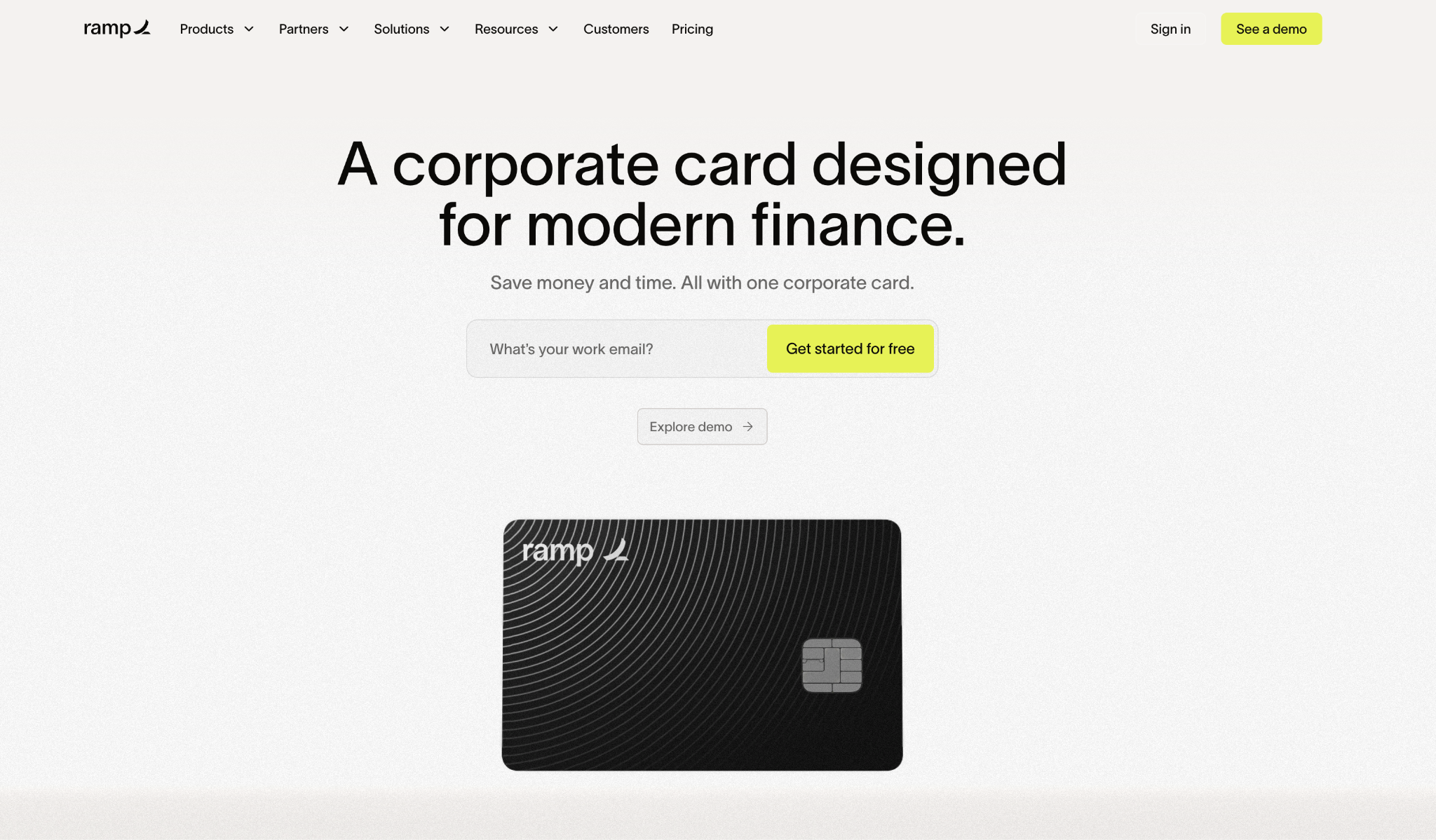
It requires $25,000 in a U.S. business bank account, works with corporations, LLCs, and limited partnerships, and issues physical and virtual cards with no personal guarantee and no annual fee.
Beyond the card itself, Ramp bundles expense management, bill pay, and accounting integrations into a single platform at no additional cost, so the card includes spend controls and reporting that most standalone programs charge extra for.
Ramp corporate card pros:
- No personal credit check or guarantee: Ramp underwrites entirely on business financials. Your personal score isn't affected during the application process, and your personal assets aren't on the hook if the company misses a payment.
- All-in-one at $0/month: Cards, expenses, bill pay, travel, and accounting integrations are available on the free tier. No annual fee and no foreign transaction fees.
- Spend controls: Finance managers can set per-card limits, enforce category restrictions, and lock cards in real time without calling support.
- Business credit reporting: Ramp reports payment activity to business credit bureaus, building a separate credit file for the company over time.
Ramp corporate card cons:
- $25,000 minimum cash: The cash requirement makes Ramp inaccessible for pre-revenue companies or founders still building their initial reserves.
- Incorporated entities only: Corporations, LLCs, and limited partnerships qualify. Sole proprietors and unregistered businesses aren't eligible.
- No revolving credit: As a charge card, the full balance is due at the end of every billing cycle. Ramp doesn't extend credit to companies that need to carry a balance.
Best for: Incorporated startups with at least $25,000 in a U.S. business bank account that want a no-credit-check corporate card with built-in expense management, no annual fee, and no foreign transaction fees.
Pricing: $0/month for the core platform. Ramp Plus is $15 per user per month for advanced controls and multi-entity support. See current rates at ramp.com/pricing.
2. Rho corporate card
Rho is a fintech platform for startups that combines corporate cards with business checking, bill pay, and treasury management.
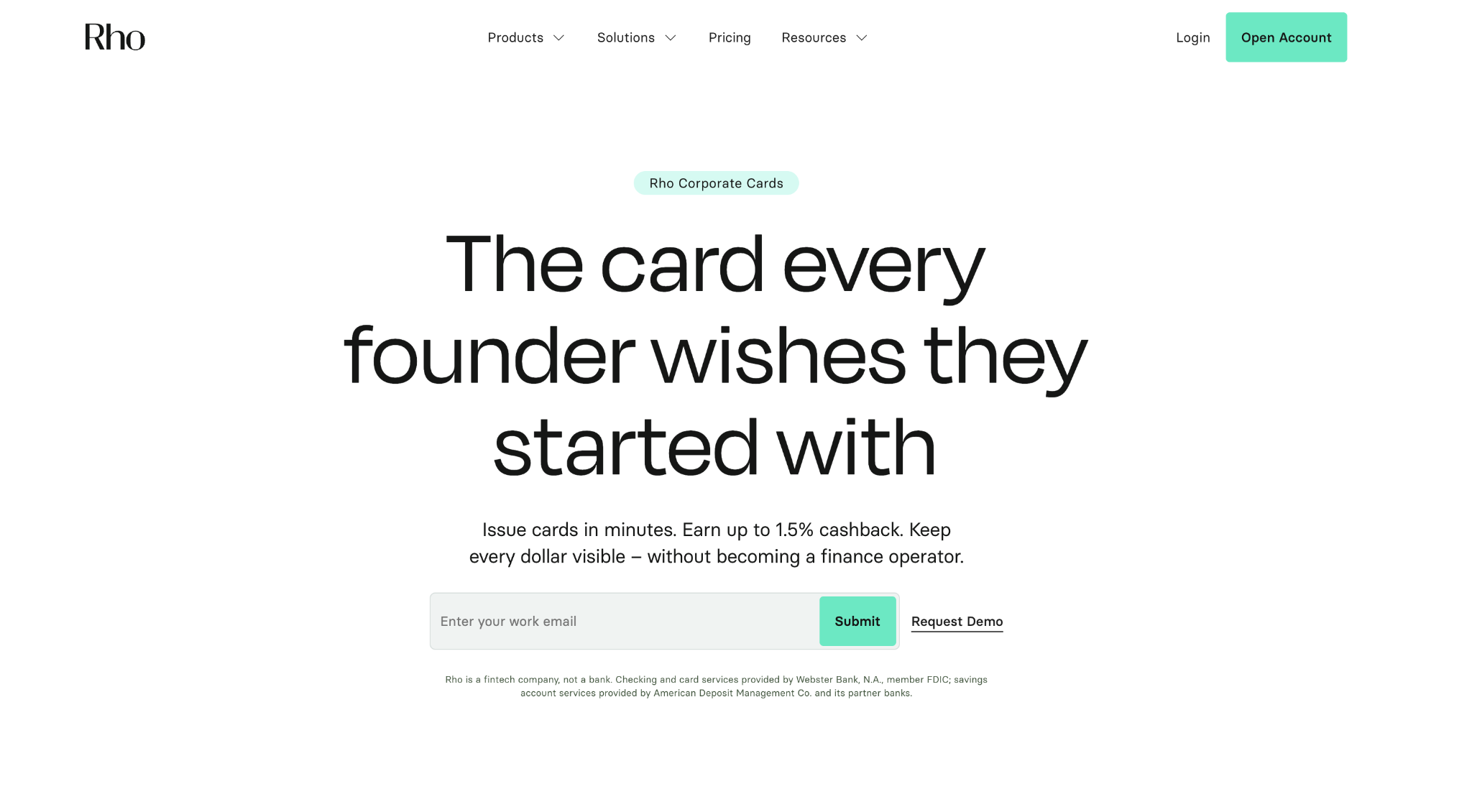
Its card runs in two modes: a daily-repayment default that earns up to 1.5% cash back, and a monthly-terms option for companies that prefer a 30-day billing cycle.
The two-tier setup matters for planning. Daily terms work well for operations with consistent daily cash inflows, since the balance settles automatically from your Rho checking account each business day. Monthly terms offer more flexibility but require $75,000 in cash to qualify.
Rho corporate card pros:
- No personal credit check: Rho reviews business cash flow and bank data. The platform does not pull personal credit reports, and card payment activity is not reported to personal credit bureaus.
- Flexible repayment tiers: Daily-repayment users earn up to 1.5% cash back on domestic spend. Monthly-terms users earn 1% with a standard 30-day billing cycle, still competitive for a no-fee charge card.
- No platform fee: Rho's checking and corporate card products carry no monthly fee for the daily-terms tier. Cards, bill pay, and treasury are available without a subscription.
- Cash back as statement credit: Rewards post directly to the statement without a portal login or separate redemption steps.
Rho corporate card cons:
- $75,000 for monthly terms: The daily-repayment default is available without that threshold, but the more flexible 30-day billing cycle requires a meaningful cash reserve to access.
- Daily repayment requires consistent inflows: Daily terms mean card charges settle from the linked Rho account each business day. Variable-revenue months can create friction with this cadence.
- Requires a Rho banking account: The card integrates with Rho's banking stack, so getting full value means moving at least part of your banking to Rho rather than keeping your existing business bank.
Best for: Startups that want a no-credit-check corporate card with no monthly fee, flexible repayment options, and the ability to bundle banking, bill pay, and treasury in one platform.
Pricing: No monthly platform fee. Daily-terms card: up to 1.5% cash back, no stated minimum cash balance. Monthly-terms card: 1% cash back, requires a $75,000 minimum cash balance. See current details at rho.co/pricing.
3. Rippling corporate card
Rippling is a workforce management platform that combines HR, payroll, IT, and finance into a single system.
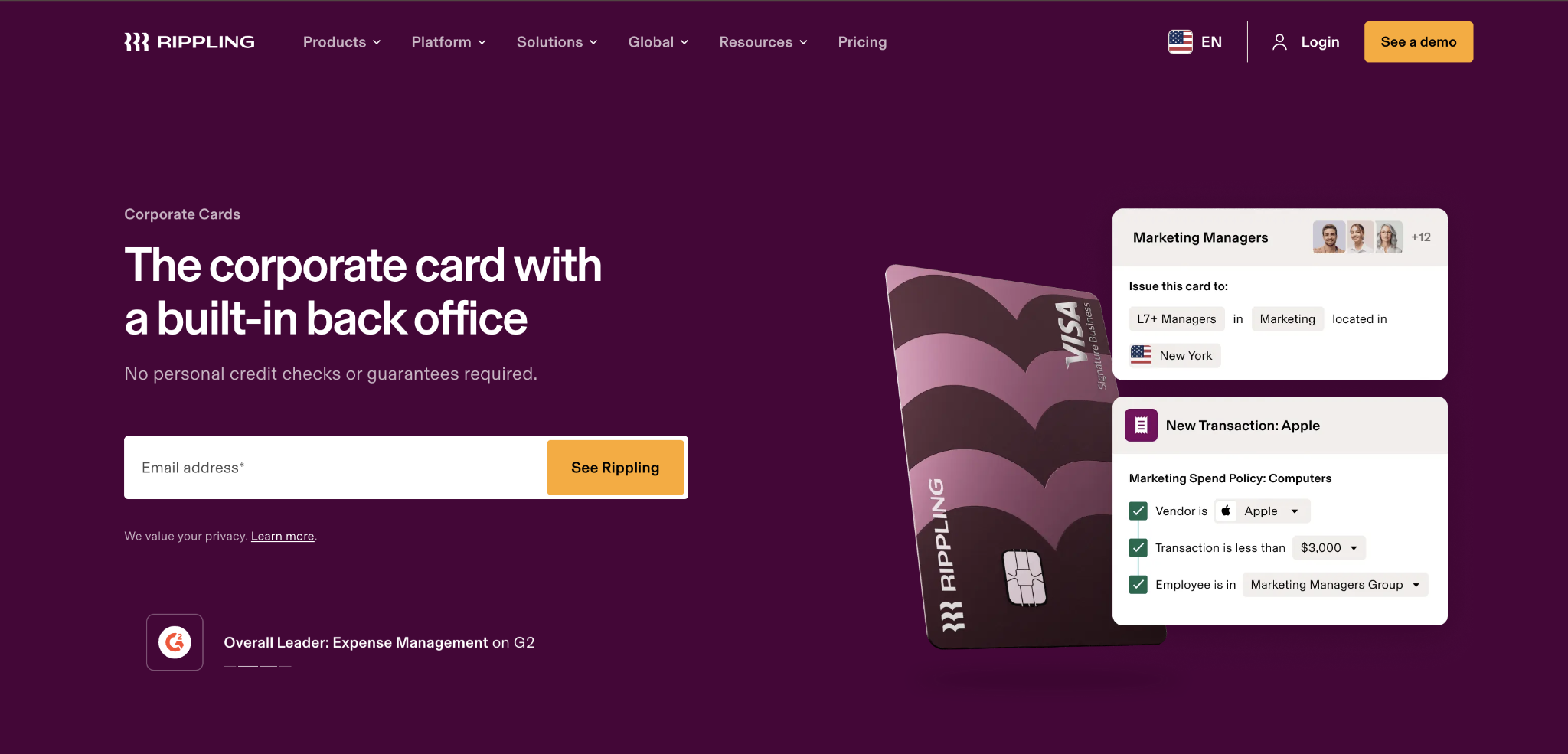
Its corporate card underwrites on business financials rather than personal credit, with no personal credit check and no personal guarantee required.
The card's main advantage isn't the card itself: it's the integration. Card charges sync directly with employee records, payroll data, and GL categories in Rippling, removing the need to reconcile card transactions against HR or accounting systems separately.
Rippling corporate card pros:
- No personal credit check or guarantee required: Rippling underwrites based on business revenue, cash flow, and bank account health. No personal credit file is accessed during the application.
- Deep platform integration: For teams already using Rippling for HR or payroll, the corporate card integrates directly with expense coding, approvals, and accounting sync, with no additional setup.
- Flexible repayment timing: Approved repayment cadence ranges from daily to monthly based on the company's cash position and Rippling's underwriting review.
- No cash-back caps or expiration: Rewards don't expire and have no category caps, so spending earns proportionally regardless of category or volume.
Rippling corporate card cons:
- Platform dependency: The card delivers most of its value inside the Rippling ecosystem. Teams that don't use Rippling for HR or payroll get fewer workflow benefits than a purpose-built card would offer.
- No published cash minimum: Rippling doesn't publicly disclose a minimum cash balance requirement, making it harder to gauge eligibility before starting an application.
- Repayment terms set at underwriting: The approved repayment cadence depends on Rippling's review rather than a stated threshold, so the terms aren't fully predictable at the application stage.
Best for: Companies already using Rippling for HR and payroll who want a no-credit-check corporate card integrated with their existing workforce management and accounting workflows.
Pricing: Rippling's corporate card pricing is bundled with the broader platform. Contact Rippling for current card pricing and platform tiers.
4. BILL Divvy corporate card
BILL Divvy is the most accessible option on this list for early-stage companies.
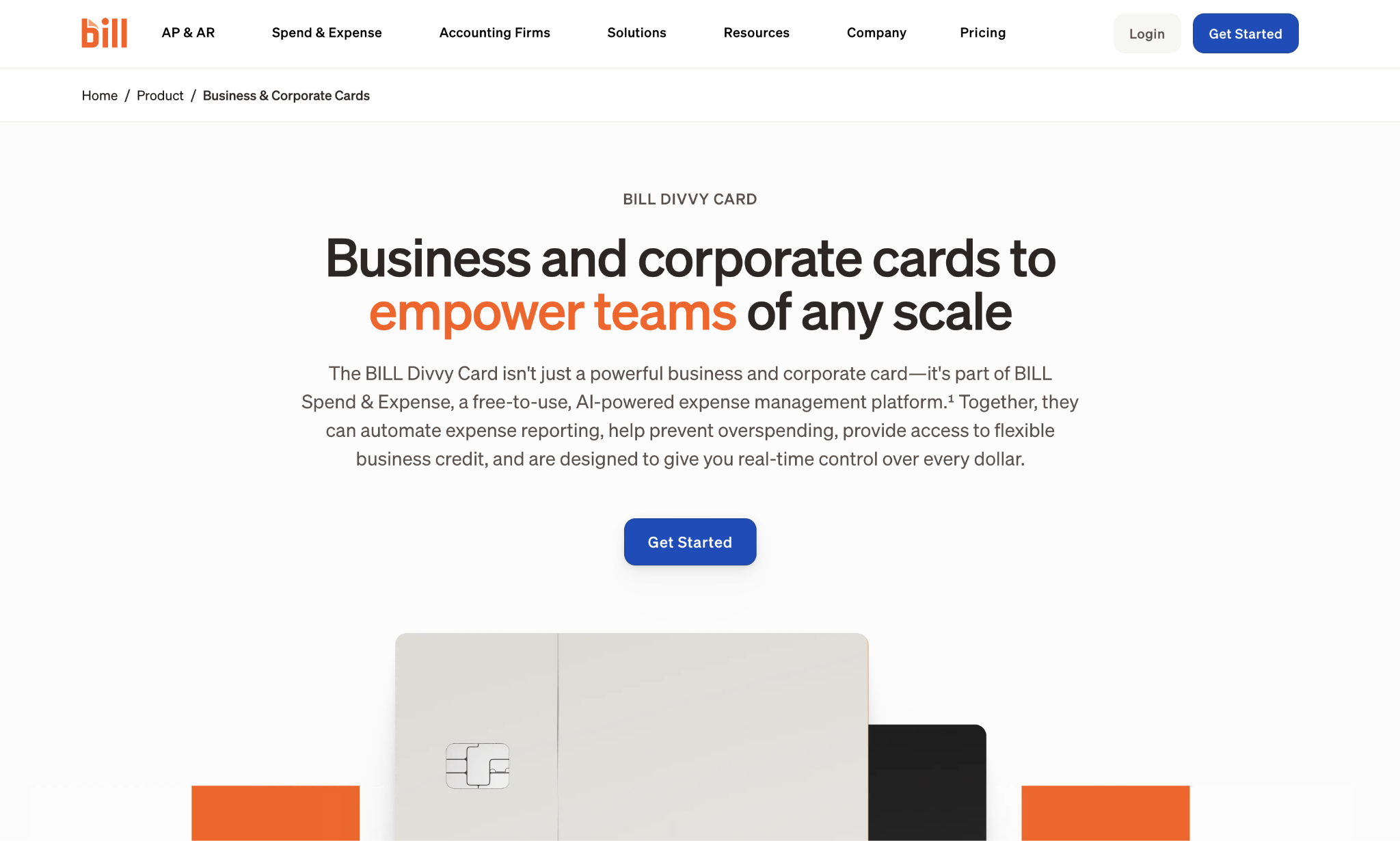
It underwrites primarily on business cash flow and bank account activity rather than a fixed cash balance, which opens the door for companies with lower reserves. It's also the only card here that accepts sole proprietors.
That accessibility comes with one trade-off: BILL Divvy runs a soft personal credit pull during the application. A soft pull won't affect your score the way a hard inquiry would, but personal credit does factor into the decision. The recommended FICO score for approval is 670 or above.
BILL Divvy corporate card pros:
- Accepts sole proprietors: Every other card on this list requires an incorporated entity. BILL Divvy accepts all business structures, including sole proprietorships, making it the most accessible option for unincorporated founders.
- Cash-flow–based underwriting: BILL Divvy evaluates the last three to six months of bank account activity rather than requiring a specific cash balance, giving early-stage companies a more flexible path to approval.
- Flexible repayment schedules: Cards can be set to daily, weekly, or monthly repayment. Higher-frequency repayment earns more reward points per dollar spent.
- Real-time spend controls: Virtual cards, per-employee limits, and transaction-level visibility are available across all plans.
BILL Divvy corporate card cons:
- Soft personal credit pull: BILL Divvy reviews personal credit during the application process. The recommended FICO score is 670+, and personal credit still factors into the approval decision.
- Tiered rewards that penalize monthly repayers: Points value varies heavily with repayment frequency. Monthly repayers earn significantly fewer points per dollar than daily repayers, and rewards are forfeited if monthly credit-line usage falls below the required minimum.
- Foreign transaction fee: BILL Divvy charges a foreign transaction fee on purchases made outside the U.S., making it less cost-effective for companies with international vendor spending.
Best for: Sole proprietors and early-stage companies that don't meet the cash minimums required by Ramp or Rho and want a card that underwrites primarily on cash flow rather than a specific balance threshold.
Pricing: No annual fee. Rewards structure varies by repayment cadence. See current terms at BILL pricing.
5. Slash business card
Slash is a financial platform for startups and founder-led companies.
Its corporate card is a Visa charge card issued by Column N.A. with full-balance repayment required daily, making it the tightest repayment cadence on this list.
The platform has grown to 10,000+ business customers and raised a $100M Series C at a $1.4B valuation. The free tier carries no monthly fee and includes unlimited virtual cards. The $25/month Pro plan adds zero-fee domestic wires and ACH transfers, along with higher cash back rates.
Slash corporate card pros:
- Unlimited virtual cards: Both free and Pro accounts issue unlimited virtual cards at no additional cost, which is useful for companies managing per-vendor card controls or running high card volumes.
- Up to 2% cash back: Pro users earn up to 2% cash back on qualifying purchases, competitive with the best flat-rate cards in this comparison.
- Multi-entity support: The platform lets teams switch between multiple entity accounts in a single interface, without separate logins, which is useful for founders managing multiple companies.
- No published cash minimum: Slash doesn't disclose a minimum cash balance requirement, making it worth exploring for companies that don't qualify for Ramp's or Rho's thresholds.
Slash corporate card cons:
- Daily full-balance repayment: Slash requires full card balance payment each day, the strictest repayment cadence in this comparison. Companies without consistent daily cash inflows may find this difficult to manage.
- Foreign transaction fee: Slash charges a 1% foreign transaction fee (minimum $0.40) on both the free and Pro tiers. For companies with regular international spending, see our guide to business credit card options with no foreign transaction fees.
- Best rewards require Pro: higher cash back rates and zero-fee domestic wires are available with the $25/month Pro plan. Free-tier rewards and transaction fees are less competitive.
Best for: Startups that want unlimited virtual cards, multi-entity support, and have consistent daily cash flow to meet Slash's daily repayment requirement.
Pricing: Free tier: $0/month with a 1% foreign transaction fee (minimum $0.40) and standard wire and ACH fees. Pro tier: $25/month with zero domestic wire and ACH fees and higher cash back. See current rates at slash.com/pricing.
How to choose a startup business credit card with no credit check
Your cash balance and entity structure narrow the list first.
If your company is incorporated as a C-corp, S-corp, LLC, or LP and holds $25,000 or more in a U.S. business bank account, Ramp covers the most ground:
- No personal guarantee
- No annual fee
- No foreign transaction fees
- Flat cash back
- A full expense management platform at $0/month
Rho is worth considering alongside Ramp if you want banking, bill pay, and treasury bundled with the card; at $75,000, you'd also qualify for Rho's monthly billing terms rather than daily repayment. For a broader view of corporate cards for startups beyond the no-credit-check category, that guide covers the full range.
For incorporated startups with $25,000 or more, Ramp offers the most comprehensive coverage with a built-in expense management platform that connects directly to your accounting system at no extra cost.
Frequently asked questions about startup business credit cards with no credit check
Do no-credit-check business cards build business credit?
Some do, and it's worth confirming before you apply if building business credit is a priority. Ramp reports payment activity to business credit bureaus, building the company's credit profile over time. Rho does not report to personal credit bureaus and reports to business bureaus at its discretion. BILL Divvy also reports to business credit agencies. Ask the issuer directly about their reporting practices before applying.
Can sole proprietors get a no-credit-check business card?
BILL Divvy is the main option on this list: it accepts all entity types, including sole proprietors and evaluates primarily on cash flow history rather than business structure. Ramp, Rho, Rippling, and Slash all require a formal corporate entity. Forming an LLC opens access to the full range of startup cards that approve on business credentials rather than personal credit.
Are these credit cards or charge cards?
All five cards on this list are charge cards, not revolving credit products. The full balance is due at the end of each repayment cycle, with no option to carry over debt or pay only the minimum. This structure allows issuers to approve spending without a personal credit check. Because there's no risk of unpaid revolving balances, underwriting can focus on whether your business has the cash flow to repay the full balance on schedule.
Does applying affect my personal credit score?
For Ramp, Rho, Rippling, and Slash, no hard personal credit inquiry is part of the standard application process, so your personal score isn't affected. BILL Divvy is the exception: it runs a soft credit pull that won't lower your score the way a hard inquiry would, but it does review personal credit as part of its approval decision, with a recommended score of 670 or above.
What cash balance do I need to qualify?
Ramp requires $25,000 in any U.S. business bank account. Rho's daily-repayment card has no stated minimum; its monthly-terms card requires $75,000. BILL Divvy evaluates cash flow with a reported minimum of around $20,000. Rippling and Slash don't publish minimum cash requirements, so eligibility depends on your company's financial profile at the time of application. Teams looking to understand the broader category of cards that underwrite on business credentials can find details in our guide to EIN-only business credit cards.


